


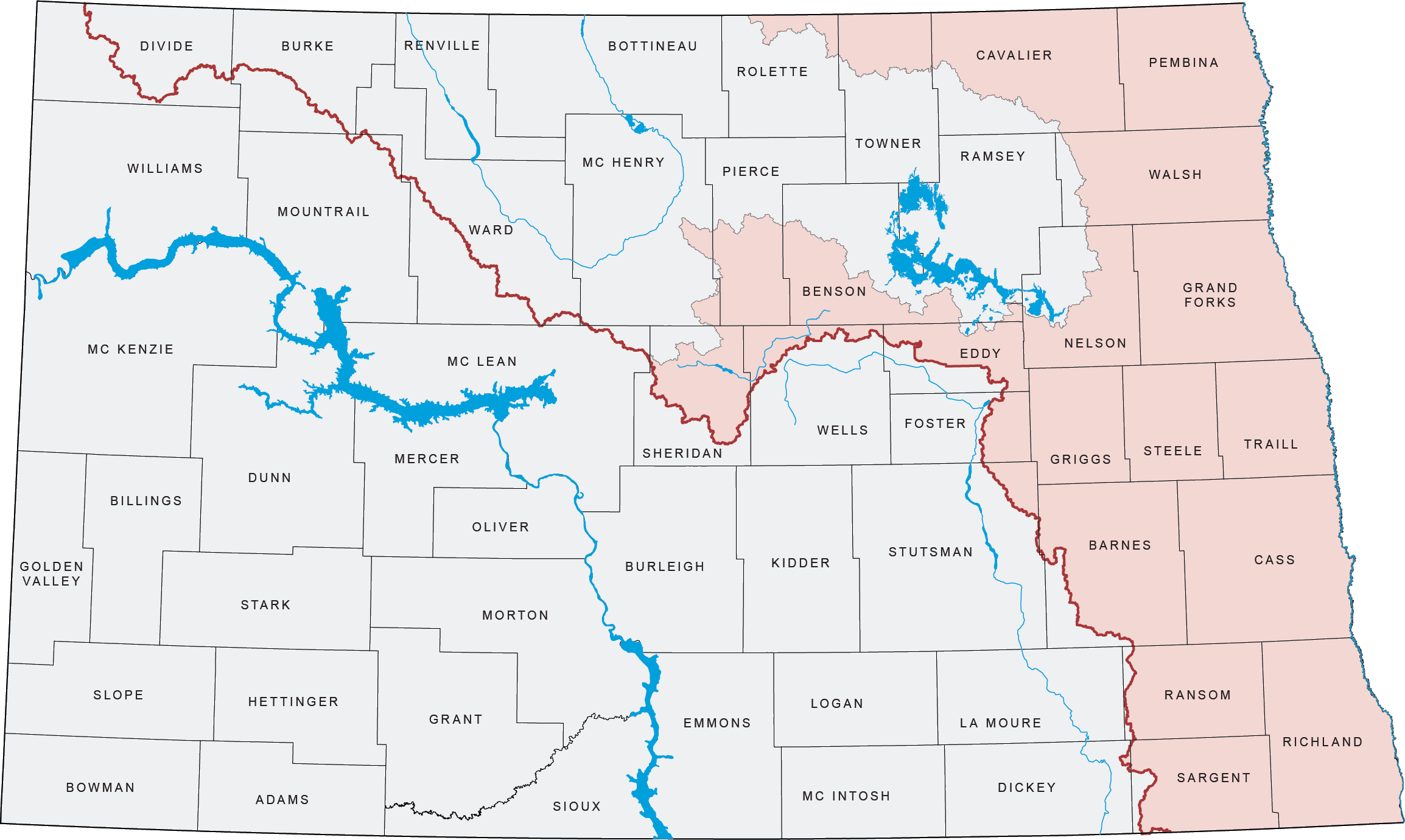
The Red River begins at the confluence of the Otter Tail River and the Bois de Sioux River near Wahpeton, North Dakota, and Breckenridge, Minnesota. From this location, the river flows north for nearly 400 river miles and forms the boundary between North Dakota and Minnesota. After crossing the Canadian border, the Red River continues north for approximately 155 river miles before emptying into Lake Winnipeg in Manitoba.
The Red River flows through the valley of what was once glacial Lake Agassiz. This former lakebed is very flat. As a result, the river has a low gradient and a winding, meandering course.
Most of the eight major tributaries in North Dakota begin in the drift prairie in the western portion of the basin. In these areas, river valleys are narrow and have steep sides. As the tributaries move east into the flat lowlands of the former lakebed, the river slopes become very shallow and watershed boundaries are less distinct.
Lake Ashtabula is the largest reservoir in the Red River Basin. This reservoir is used for flood control and water supply. It is located on the main channel of the Sheyenne River and has a maximum storage capacity of 200,000 acre-feet.
Approximately 70 percent of the Red River Basin is devoted to cropland. This is the highest percentage of cropland among the state’s five major river basin
Additional Red River Basin information and supporting data are provided on the following pages:
- Red River Basin Map
- Red River Basin Programs & Organizations
- Red River Basin Reports and Publications
- Red River Basin Water Data
- Red River Joint Water Resource District (RRJWRD)
Information
For more information on the Red River Basin, please contact the Red River Engineer at (701) 328-9049 or e-mail.