


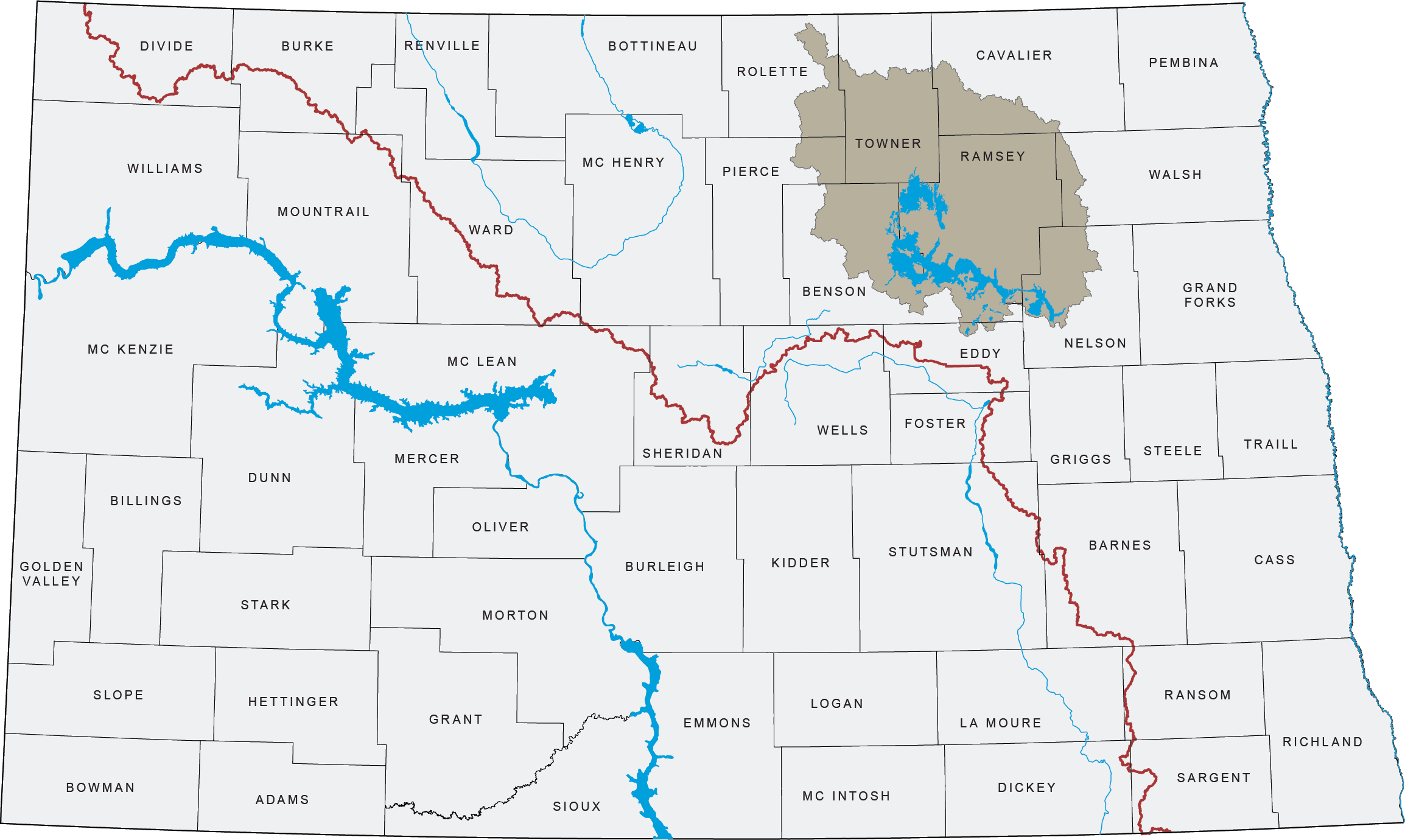
The Devils Lake Basin, located in northeast North Dakota, is a subbasin of the Red River of the North Basin. Devils Lake and Stump Lake are the two primary closed-basin lakes situated at the southern edge of the basin. As closed-basin systems, these lakes receive and store runoff from their respective drainage areas, causing water levels to fluctuate dramatically in response to changing climatic conditions.
Geologic evidence indicates that over the past 10,000 years, Devils Lake and Stump Lake have both overflowed into the Sheyenne River and dried up completely on multiple occasions. More recent history demonstrates that extreme lake-level fluctuations remain possible. In 1940, Devils Lake was nearly dry at an elevation of 1,401 feet (NGVD 29). By June 2011, the lake reached a modern-day record elevation of 1,454.3 feet. This rise of more than 53 feet resulted in an expansion of the lake surface area by over 300 square miles.
Since 1993, the Devils Lake Basin has experienced a prolonged wet cycle that has significantly impacted basin residents. Flooding has threatened communities, inundated tens of thousands of acres of agricultural land, and forced the abandonment of homes, roads, and other critical infrastructure. In response to these conditions, the State of North Dakota has taken an active role in flood prevention and mitigation within the basin.
The State’s flood mitigation efforts are guided by three primary strategies:
- Construction and Operation of Outlets to the Sheyenne River
- Basin-Wide Water Management
- Protection of Critical Infrastructure
Additional Devils Lake Basin information and supporting data are provided on the following pages:
- Devils Lake Basin Maps
- Devils Lake Basin Outlets & Tolna Structure
- Devils Lake Basin Reports and Publications
- Devils Lake Basin Water Data
- Devils Lake Basin Joint Water Resource Board
Information
For more information on the Devils Lake Basin, please contact Yaping Chi, Water Resource Engineer at (701) 328-9049.